Best Apps for Armwrestling Training in 2026 (And Why Generic Fitness Apps Fall Short)
2026-09-13 · 3 min read
Searching for "best workout apps" turns up the same handful of names every time — general fitness trackers built for gym-goers, runners, and bodybuilders. None of them were built with wrist curls, pronation work, or table time in mind. Here's an honest comparison of what those apps actually do well, where they fall short for armwrestling specifically, and what to look for instead.
What general fitness apps actually do well
Apps like generic gym-log trackers and running apps are genuinely good at a few things: broad exercise libraries, simple set/rep logging for standard lifts, calorie and macro tracking, and — for the ones with a map feature — finding a gym near you. If your training is 90% generic gym work, one of these will serve you fine for that slice.
The usual suspects here are Strong, Hevy, and RepCount — three of the most popular gym-logging apps. Strong and Hevy are polished, social, and great for barbell/dumbbell splits; RepCount keeps things minimal and fast. All three are excellent at what they were built for. None of them were built for a puller.
Where they fall short for armwrestling
- No armwrestling-specific exercise library. Wrist curls and pronation curls might exist as generic entries, but there's no context connecting them to hook technique, toproll, or side pressure — you're logging numbers with no sense of what they're building toward.
- No left/right arm tracking. Armwrestling strength is often asymmetric between your dominant and off arm, and generic trackers assume a single number per lift, not two arms competing for the same table time. Training both arms matters for exactly this reason.
- No table time or match tracking. Live pulling sessions and matches are a different training stimulus from a gym set — an app that only understands "exercise, sets, reps" has no field for that.
- No armwrestling-specific programming. A real training plan needs pronation/supination work, static holds, and side pressure drills structured around a weekly split — generic apps don't have templates for any of it.
Track your armwrestling training with ArmProgress — log it, see the trend, get stronger.


What to actually look for in an armwrestling training app
- An exercise library that separates hook, toproll, and side-pressure-relevant movements, not just a flat list of generic lifts
- Left and right arm tracked separately, since match-day performance depends on your weaker side as much as your stronger one
- A way to log table sessions and matches alongside gym work, not just standard exercises
- Progress charts built around the specific numbers that matter — grip strength trends, pronation/supination progression, not just total volume lifted
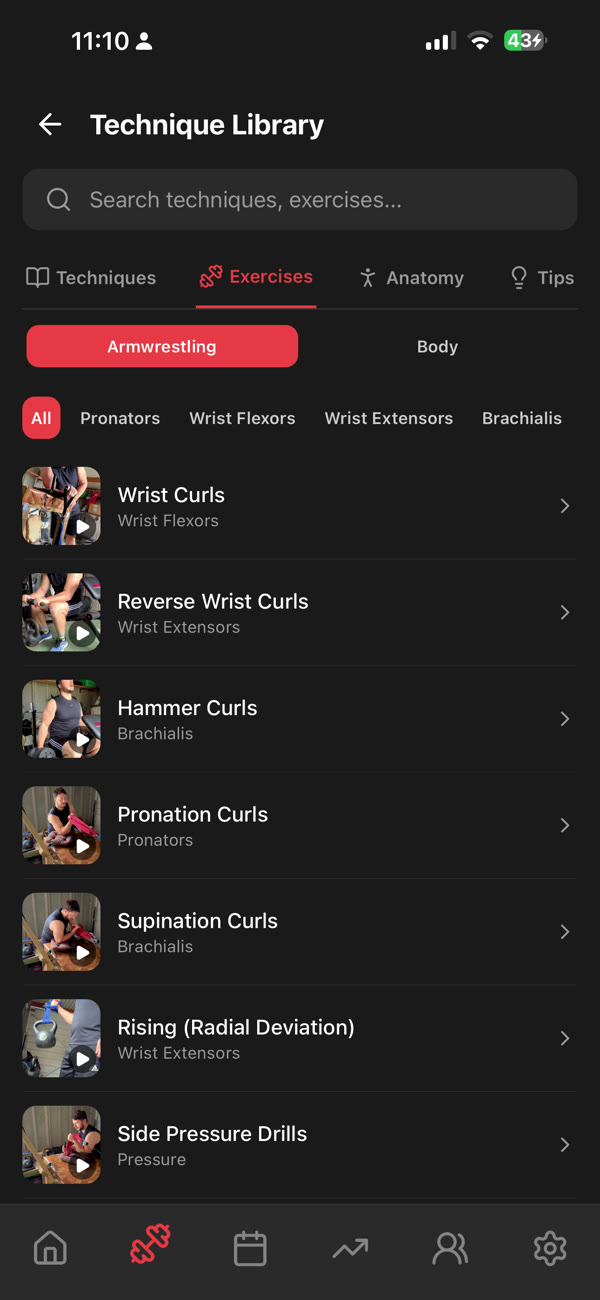
This is what a purpose-built library looks like — armwrestling movements grouped by the muscles and techniques they build, with a demo video on every one:
Strong vs Hevy vs RepCount vs ArmProgress
| Strong | Hevy | RepCount | ArmProgress | |
|---|---|---|---|---|
| Built for | General lifting | General lifting + social | Minimal gym logging | Armwrestling |
| Armwrestling exercise library | No | No | No | Yes |
| Hook / toproll / side-pressure context | No | No | No | Yes |
| Separate left/right arm tracking | No¹ | No¹ | No | Yes |
| Table time & match logging | No | No | No | Yes |
| Pronation / supination & static-hold programming | No | No | No | Yes |
| Grip-strength & arm-specific progress charts | No | No | No | Yes |
¹ You can create two separate custom exercises as a workaround, but there's no real arm-aware tracking, comparison, or match-day read-out.
The honest takeaway
Generic fitness apps aren't bad — they're just not built for this sport. If armwrestling is a small part of a broader fitness routine, a general tracker plus a notebook for table sessions might genuinely be enough. But if you're training seriously for the table, an app that actually understands hook, toproll, and pronation work — and tracks your left and right arm separately — closes a gap that generic apps were never designed to fill. That's the specific problem ArmProgress was built to solve.
Frequently asked questions
What is the best app for armwrestling training?
Look for an app built specifically for armwrestling — one with a hook/toproll/side-pressure-aware exercise library, separate left and right arm tracking, and the ability to log table sessions and matches, not just standard gym lifts.
Can I use a general fitness app for armwrestling training?
You can log basic gym exercises in one, but generic fitness apps have no armwrestling-specific exercise context, no left/right arm tracking, and no way to log table time or matches — you'll be missing the data that actually predicts match performance.
Why does left and right arm tracking matter for armwrestling?
Armwrestling strength is often asymmetric between your dominant and off arm, and match performance depends on both. Generic trackers log one number per lift with no arm distinction, hiding an imbalance until it shows up at the table.
Train like an armwrestler
ArmProgress is the training tracker built for armwrestling — log table time and gym work, track left/right, watch your numbers climb, and get AI-powered insights.